
Early Detection for Better Student Mental Health Outcomes
Clinicom empowers schools and universities to screen for mental health concerns early, respond quickly, and monitor progress over time with minimal staff burden.

invite

assess

treatment

patient tracking
Stigma, limited resources, and overextended staff leave many struggling in silence, with little visibility into overall student well-being.
- Mental health concerns among students are rising, with limited clinical support on campuses.
- Many students struggle silently due to stigma or lack of awareness.
- Educators and school counselors are overextended and often lack tools for structured assessments.
- There is little visibility into trends or progress across student populations.
Complete the form to book your personal demo
Making the Invisible Visible
Freeing Up Counselor Capacity
Sustaining Student Support
Clinicom enables schools to automate progress checks and provide actionable reports over time.
Scaling Support for Student Mental Health
Students face complex mental health challenges, and educators need scalable tools to respond. Clinicom brings early detection, ongoing tracking, and real impact to student care.
CUSTOMER FEEDBACK
Why Is Clinicom Important?
Scalable, evidence-based tools to support and strengthen student mental health
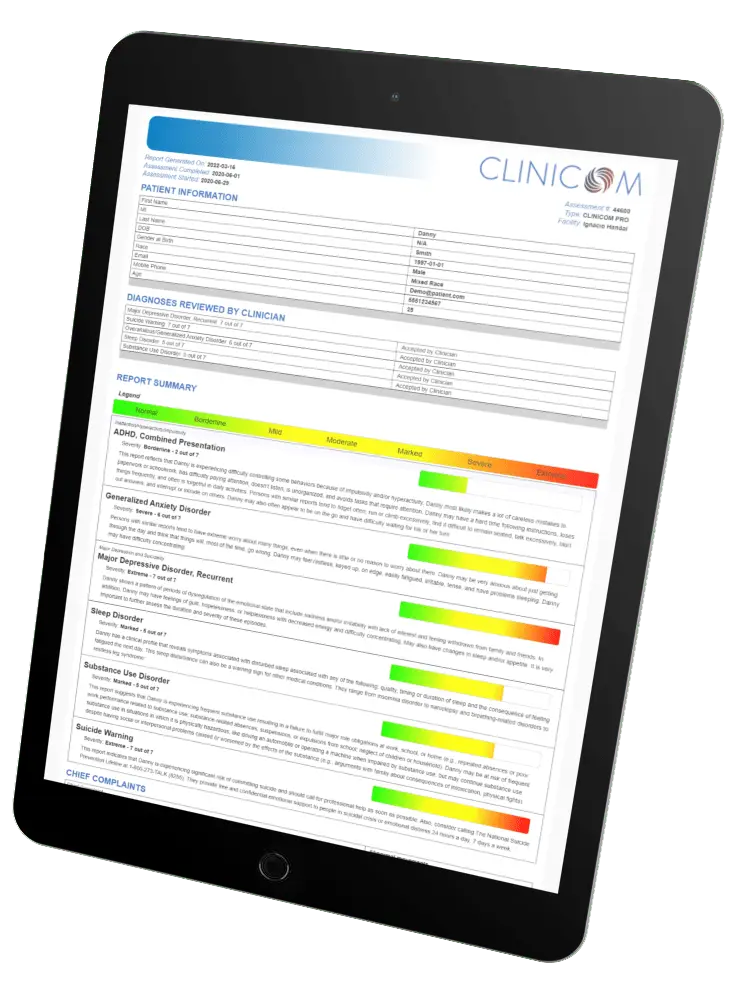
Clinicom streamlines the intake process for clients in substance use recovery by uncovering hidden mental health challenges that often go unnoticed. Through an adaptive, evidence-based questionnaire, Clinicom screens for over 80 psychiatric conditions with high accuracy, helping clinicians quickly identify co-occurring disorders. The platform then generates condition-specific insights to guide integrated treatment planning and supports ongoing recovery through scheduled follow-ups and progress tracking. With Clinicom, providers can deliver more personalized, effective care—without adding to their workload.
Step 1
Digital intake begins on admission, covering biopsychosocial factors and past diagnoses.
Step 2
Adaptive assessment drills down based on substance use history and symptoms.
Step 3
The system generates a clinical profile with comorbidities and care recommendations.
Step 4
Structured documentation supports case review and compliance.
Step 5
Follow-up schedules can be automated for post-discharge care tracking.